The loafer, that slip-on shoe often associated with preppy sophistication or effortless cool, has a history far more complex than its minimalist design suggests. Its journey from Ivy League campuses to punk rock mosh pits and high-fashion runways reads like a cultural odyssey, reflecting shifting attitudes toward class, gender, and self-expression. This unassuming shoe has been claimed and reclaimed by subcultures, each imprinting their own meaning onto its leather upper.
Origins: A European Transplant Takes Root in American Soil
Contrary to popular belief, the loafer wasn’t born in the hallowed halls of Harvard or Yale. Its earliest incarnation traces back to 19th-century Norwegian farmers who wore slip-on moccasins for practicality. In the 1930s, American travelers brought the design home, where it was refined by brands like G.H. Bass. The Weejun (a play on "Norwegian") became the first commercially successful loafer, its beefroll stitching and low profile signaling understated wealth. This was footwear for those who didn’t need to try hard—the very essence of old-money aesthetics.
Post-WWII, the loafer became the unofficial uniform of Ivy League students. Paired with rolled-up chinos and a button-down, it represented a rejection of ostentation. The penny loafer (named for the coin slot on its strap) allowed wearers to telegraph subtle rebellion—a dime stored there could supposedly make an emergency phone call. This was rebellion lite, of course, but it hinted at the shoe’s future as a blank canvas for subversion.
The 1960s-70s: Subcultural Shape-Shifting
As youth movements gained momentum, the loafer was drafted into service by groups with radically different agendas. Mods in Britain paired polished loafers with slim suits, creating a razor-sharp silhouette. Across the Atlantic, the shoe became a staple among African American jazz musicians, who favored tassel loafers with sharply tailored looks—a sartorial middle finger to racist respectability politics.
Perhaps most surprising was the loafer’s adoption by skinheads in the late 60s. Before the subculture became associated with extremism, working-class youths wore loafers with braces and Levi’s as part of a clean-cut aesthetic that parodied middle-class norms. The contradiction of a "gentleman’s shoe" on the feet of anti-establishment youth wasn’t lost on observers—it was precisely the point.
Punk’s Unexpected Muse
When Malcolm McLaren brought the loafer to the punk scene via the Sex Pistols, it completed the shoe’s transformation from status symbol to anti-symbol. Spray-painted, studded, and worn with ripped stockings, the loafer became a weapon against its own heritage. Vivienne Westwood’s "Buffalo" loafers with stacked soles exaggerated the shoe’s proportions into something grotesque—a parody of consumerism. That such a refined silhouette could be made to look so deliberately ugly spoke volumes about punk’s disdain for convention.
In 1980s Japan, the loafer took on new life through the otoko-no-komon (male femme) movement. Designer Mitsuhiro Matsuda sent models down the runway in loafers with delicate heels and feminine detailing, challenging gender norms years before the unisex footwear boom. Meanwhile, American prep culture experienced a revival thanks to The Preppy Handbook, making the loafer once again a marker of privilege—this time with a self-aware, almost kitschy edge.
Streetwear’s Luxury Plaything
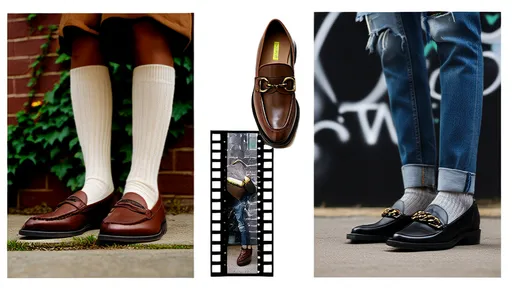
The 2010s saw the loafer absorbed into streetwear’s ecosystem. Gucci’s princely horsebit loafers became ironic flexes when worn with distressed denim. Collaborations between heritage brands like Tod’s and streetwear labels blurred the lines between high and low. Suddenly, the shoe that once signaled establishment values was being customized with graffiti and worn with hoodies.
Today’s iterations range from Bottega Veneta’s exaggerated rubber-soled versions to avant-garde takes with deconstructed uppers. The loafer has been veganized, chunky-fied, and reimagined in every conceivable material. Its endurance lies in its mutability—it can signify rebellion or tradition depending on who wears it and how. As fashion continues to mine nostalgia while pushing boundaries, the loafer remains the ultimate shape-shifter: always familiar, never predictable.
What began as practical footwear became a semiotic playground, its meaning rewritten with each generation. The loafer’s true genius lies in its ability to be everything at once—a status symbol and its antithesis, a relic and a revolution.

By /Aug 1, 2025
By /Aug 1, 2025

By /Aug 1, 2025

By /Aug 1, 2025

By /Aug 1, 2025
By /Aug 1, 2025
By /Aug 1, 2025
By /Aug 1, 2025
By /Aug 1, 2025
By /Aug 1, 2025

By /Aug 1, 2025

By /Aug 1, 2025

By /Aug 1, 2025

By /Aug 1, 2025

By /Aug 1, 2025

By /Aug 1, 2025

By /Aug 1, 2025

By /Aug 1, 2025

By /Aug 1, 2025

By /Aug 1, 2025